01 — The Opportunity
Minimizing equipment losses and infrastructure failures
The Opportunity
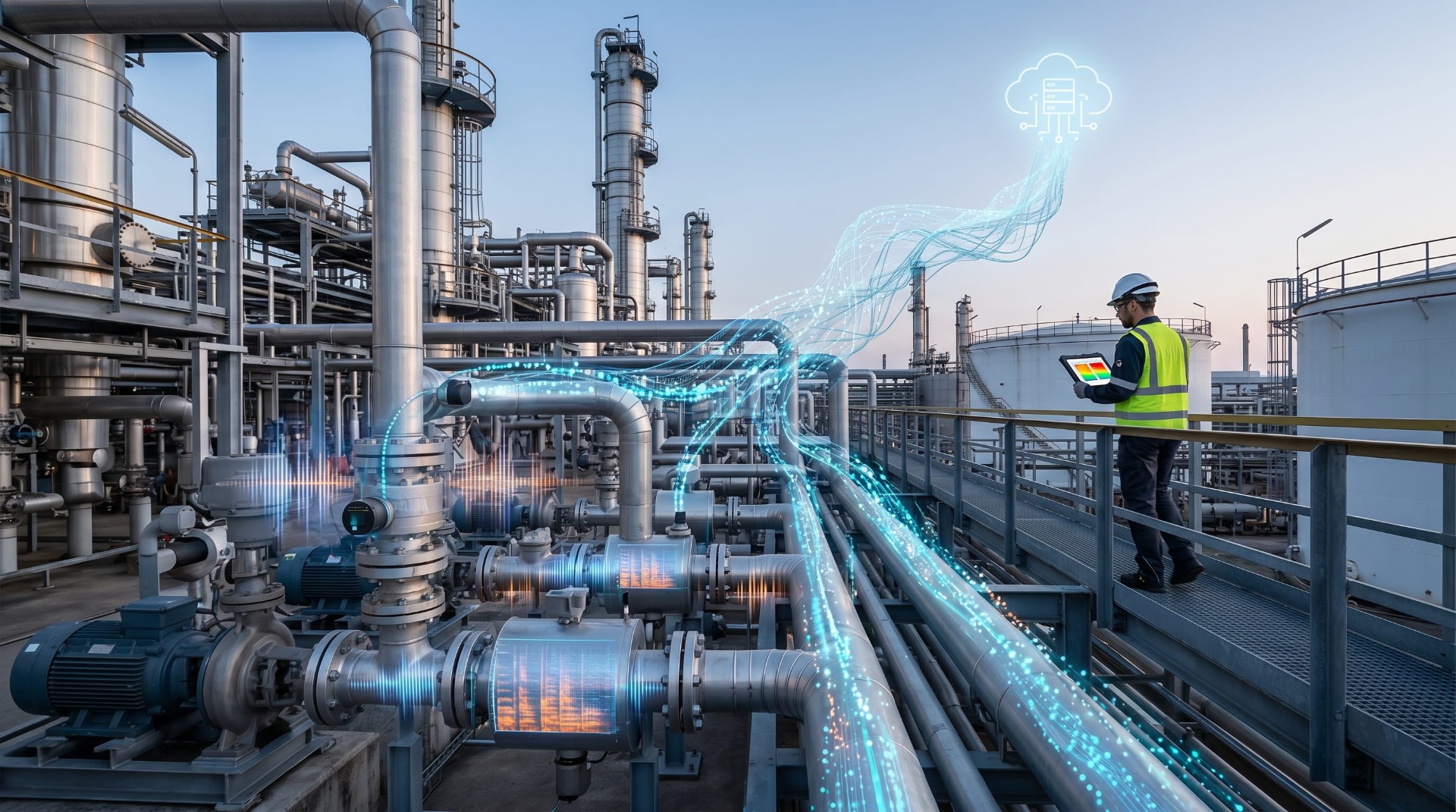
A major energy and industrial infrastructure operator faced persistent, costly losses from undetected equipment failures across its compressed air, steam, and gas distribution systems. Leaks in pressurized systems, often invisible to the naked eye and inaudible to the human ear at early stages, were silently draining energy, increasing operational costs, and accelerating equipment degradation. Maintenance decisions were driven by scheduled intervals and operator instinct rather than actual equipment condition, meaning some assets were over-maintained while others deteriorated undetected until catastrophic failure. Over 30 years of operational data existed across the organization, but it was fragmented across paper records, legacy systems, and disconnected spreadsheets, making historical trend analysis and evidence-based planning impossible.
- 01Compressed air, steam, and gas distribution systems experiencing undetected leaks, silently draining energy and accelerating equipment wear.
- 02Maintenance driven by fixed schedules and operator instinct rather than actual equipment condition, resulting in both over-maintenance and undetected failures.
- 0330+ years of operational data fragmented across paper records, legacy systems, and disconnected spreadsheets, no historical trend analysis capability.
- 04Regulatory and safety compliance requiring documented evidence of proactive maintenance, instinct-driven approaches increasingly untenable.
02 — The Solution
Analytics-based decision-making and Audio Analytics
The Solution
We executed a two-pronged transformation: first, consolidating over 30 years of fragmented operational data into a scalable cloud infrastructure, digitizing paper records, normalizing legacy system exports, and structuring unstructured maintenance logs into a queryable analytical environment. Second, we implemented a cutting-edge audio analytics infrastructure that uses ultrasound frequency pattern analysis to detect, classify, and size leaks non-invasively. The system distinguishes between leak types, compressed air, steam, gas, and estimates leak magnitude based on frequency signatures, enabling maintenance teams to prioritize interventions by economic impact rather than discovery sequence.
- 01Scalable cloud infrastructure consolidating 30+ years of data.
- 02Digitized capture across structured and unstructured sources.
- 03Tableau-powered visualization environment for evidence-based decision making.
- 04Real-time audio analytics for non-invasive leak detection.
- 05Leak classification by type (compressed air, steam, gas) and estimated magnitude, enabling prioritization by economic impact.
- 06Historical trend analysis unlocked for the first time, 30 years of maintenance patterns made queryable and visualizable.
03 — The Impact
From instinct-driven to evidence-based culture
The Impact
The deployment transformed both the technical maintenance capability and the organizational culture around equipment management. Maintenance teams shifted from calendar-based routines to condition-based interventions, directing effort where data indicated the highest loss potential. The audio analytics system gave field teams a non-invasive, quantitative tool that replaced subjective assessments with measurable, repeatable diagnostics. Leadership gained, for the first time, a historical view of equipment performance trends that informed capital expenditure planning and preventive maintenance investment priorities.
- 0111 distinct types of equipment aberrations addressed.
- 02Significant reduction in losses tied to undetected infrastructure failures.
- 03Organizational culture shifted to evidence-based maintenance and operations.
- 04Condition-based maintenance replacing calendar-based routines, directing resources to highest-impact interventions.
- 05Capital expenditure planning informed by 30 years of historical equipment performance data for the first time.
- 06Regulatory compliance documentation strengthened through automated, data-backed maintenance records.
Ready to build your success story?
The next phase of your data story starts here.
Start a conversation