01 — The Opportunity
Strategic misalignment in cultural site development
The Opportunity
A government authority in the Middle East responsible for cultural heritage preservation and development faced a strategic planning challenge with significant long-term implications. As the authority planned future cultural site developments, museums, heritage centers, archaeological preservation zones, and public cultural spaces, decision-makers lacked a unified visual understanding of how population centers, existing historical landmarks, tourism corridors, and proposed new sites related geographically. Investment decisions were being made based on political advocacy, historical precedent, and intuition rather than evidence. This created a material risk of misaligned resource allocation: over-investing in regions already well-served by cultural infrastructure while underserving high-population areas with limited cultural access. Given that these investments represent decades-long commitments of public capital, the cost of misallocation was not just financial, it was a missed opportunity to maximize cultural reach, heritage preservation, and community engagement for an entire generation.
- 01Cultural site investment decisions driven by advocacy and precedent rather than evidence, risking misaligned resource allocation across regions.
- 02No unified geographic view connecting population density, existing landmarks, tourism corridors, and proposed new developments.
- 03High-population areas potentially underserved by cultural infrastructure, invisible without systematic spatial analysis.
- 04Decades-long capital commitments requiring evidence-based justification, the cost of misallocation extends far beyond the financial.
02 — The Solution
Geographic correlation and population layering
The Solution
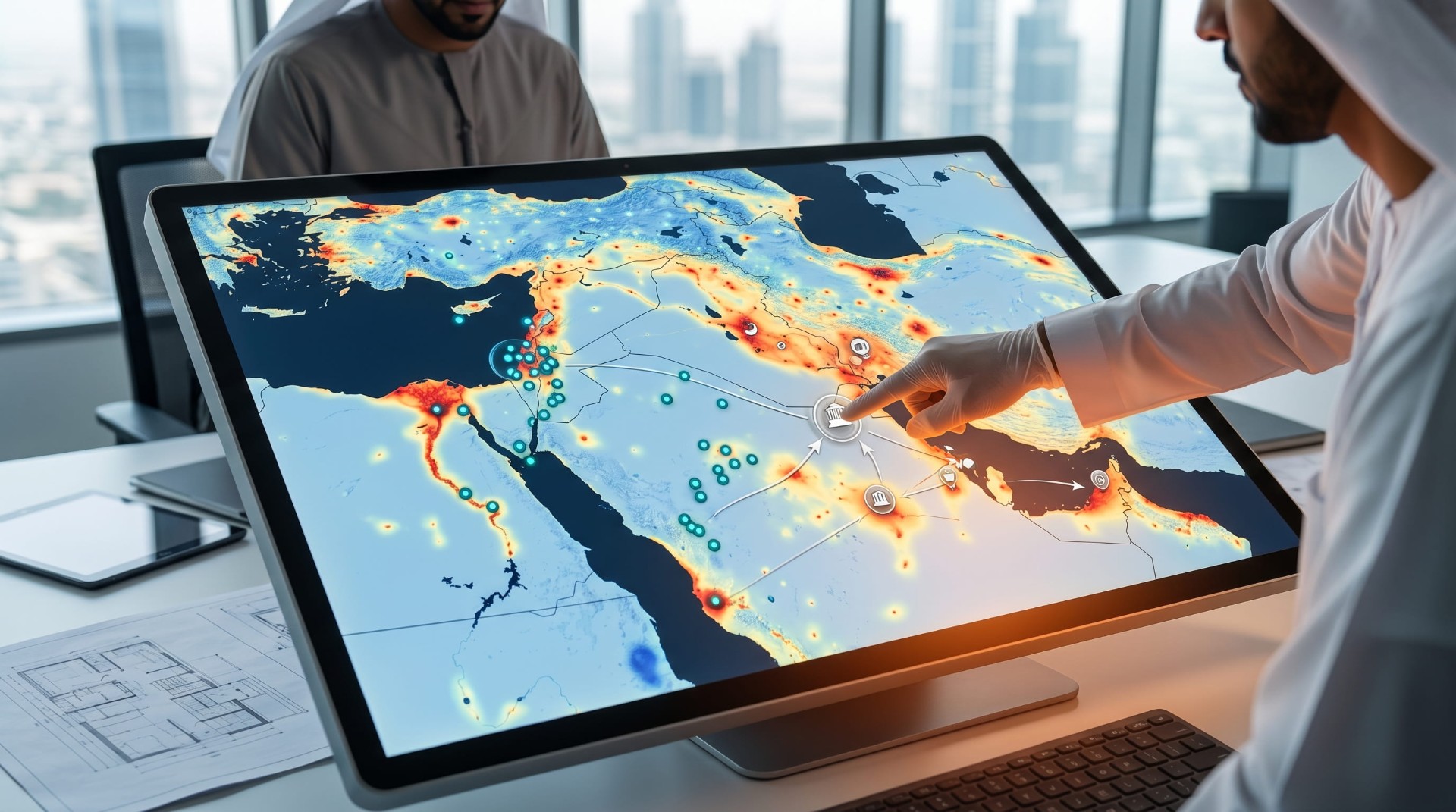
We developed a dynamic geographic visualization suite purpose-built for cultural infrastructure planning, layering proposed development sites against high-resolution population density data, existing historical landmark locations, tourism flow patterns, and transportation accessibility networks. The visualization environment was designed for decision-makers rather than analysts: intuitive, interactive, and capable of answering strategic questions through direct manipulation rather than report requests. Precise gap analysis became possible for the first time, identifying regions where population density warranted cultural investment but no infrastructure existed, and conversely, regions where existing landmarks were clustered but underutilized due to accessibility constraints.
- 01Layered proposed sites against live population density data.
- 02Mapped historical landmark proximity to identify cultural clusters.
- 03Visualized geographic accessibility for equitable development planning.
- 04Correlated demographic data with cultural reach projections.
- 05Tourism flow and transportation network overlays, identifying accessibility constraints that limit existing landmark utilization.
- 06Interactive scenario planning, enabling decision-makers to evaluate alternative site configurations and their projected reach before committing capital.
03 — The Impact
Evidence-based preservation and public outreach
The Impact
The project shifted cultural site planning from intuition-led to evidence-based, giving the government authority a defensible, data-backed framework for capital allocation decisions that will shape the region's cultural landscape for decades. Investment priorities were reordered based on quantified population reach, accessibility analysis, and heritage preservation potential rather than political advocacy. The visualization suite became a permanent planning tool, used not just for the initial prioritization exercise but as an ongoing capability for evaluating future proposals, monitoring cultural reach metrics, and reporting outcomes to stakeholders.
- 01Identified underserved regions for prioritized investment.
- 02Maximized cultural reach per dollar of infrastructure spend.
- 03Established a data-driven framework for long-term heritage preservation.
- 04Investment justification strengthened through quantified population reach and accessibility analysis, supporting transparent public capital allocation.
- 05Visualization suite adopted as a permanent planning tool, extending value beyond the initial engagement into ongoing strategic planning.
- 06Framework designed for replicability, applicable to cultural heritage planning across other regions and government authorities.
Ready to build your success story?
The next phase of your data story starts here.
Start a conversation